
Navigating the NDIS can feel overwhelming, especially when you are trying to understand funding categories, connect with reliable providers, organise appointments, and make sure your plan is actually helping you achieve your goals. This is where the right support coordinator can make a life-changing difference.
A skilled NDIS support coordinator does far more than simply recommend providers. They help participants build confidence, strengthen independence, solve problems, manage challenges, and create a support network that genuinely improves daily life.
For participants and families in Brisbane, choosing the right support coordinator is one of the most important decisions in the entire NDIS journey. The right coordinator keeps things moving, communicates clearly, and helps reduce stress. The wrong one can leave participants confused, unsupported, and disconnected from essential services.
This guide explains how to choose the best NDIS support coordinator in Brisbane, what qualities to look for, common mistakes to avoid, and how quality coordination can help maximise your NDIS plan.
Who is a NDIS Support Coordinator?
An NDIS support coordinator helps participants understand and implement their NDIS plan effectively. Their role is to connect participants with suitable services, build capacity, manage challenges, and ensure supports align with personal goals.
Support coordination is designed to help participants:
- Understand their NDIS funding
- Connect with providers
- Coordinate multiple services
- Build independence and confidence
- Resolve service delivery issues
- Prepare for plan reviews
- Access community supports
- Strengthen long-term capacity
Support coordinators often become a central point of communication between participants, families, providers, therapists, and support teams.
Types of NDIS Support Coordination
Understanding the different levels of support coordination is essential before choosing a provider.
Support Connection
Support Connection focuses on helping participants learn how to use their NDIS plan independently. It is generally short-term and capacity-building focused.
Coordination of Supports (Level 2)
This is the most common form of support coordination. It helps participants organise services, manage providers, monitor budgets, and build support networks.
Level 2 support coordination may include:
- Service referrals
- Provider coordination
- Budget monitoring
- Assistance with appointments
- Support plan implementation
- Community participation support
- Advocacy and problem solving
Specialist Support Coordination (Level 3)
Specialist Support Coordination is designed for participants with complex needs, high risks, or challenging life circumstances.
This may include:
- Mental health complexities
- Justice involvement
- Housing instability
- Child protection concerns
- Crisis management
- Hospital discharge support
- High intensity support coordination
Specialist coordinators often work alongside multiple agencies and clinical teams.
Why Choosing the Right Support Coordinator Matters
The quality of support coordination can significantly affect outcomes for participants and families.
A strong support coordinator helps:
- Reduce stress and confusion
- Improve access to services
- Prevent provider breakdowns
- Maximise funding usage
- Increase independence
- Strengthen communication
- Support crisis prevention
- Improve long-term outcomes
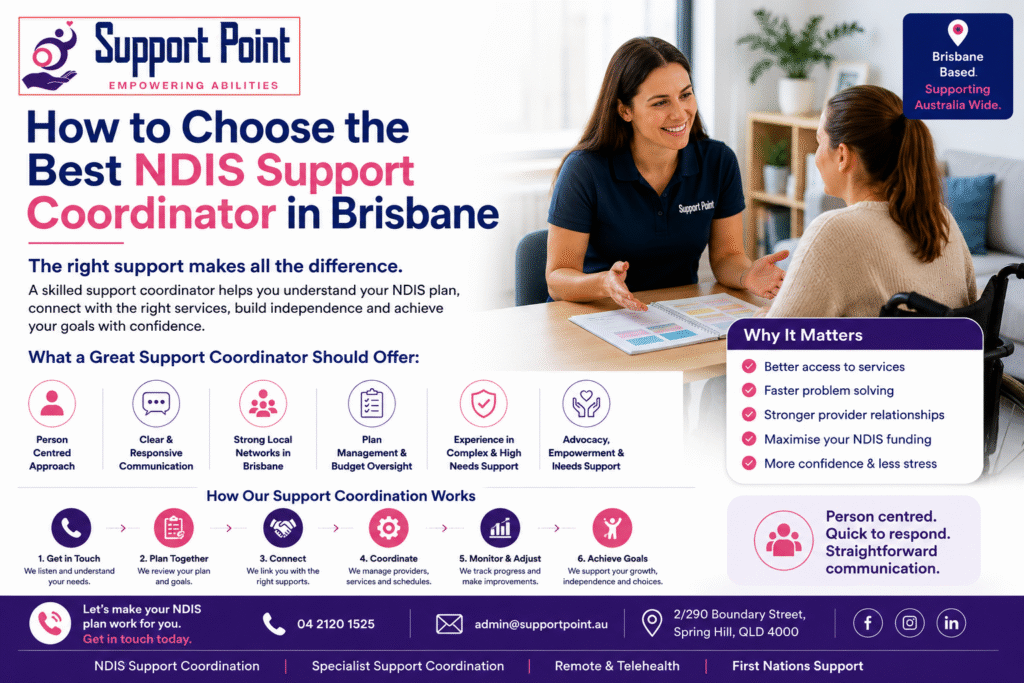
Many participants discover that effective coordination leads to faster service access, better provider relationships, and improved confidence in managing the NDIS.
Key Qualities to Look for in an NDIS Support Coordinator
1. Strong Communication Skills
Clear communication is one of the most important qualities in a support coordinator.
Your coordinator should:
- Explain the NDIS in plain language
- Return calls and emails promptly
- Keep you updated regularly
- Listen carefully to your goals and concerns
- Advocate confidently when required
Poor communication often creates delays, misunderstandings, and unnecessary stress.
2. Person-Centred Approach
Every participant has different goals, challenges, cultural backgrounds, and support needs.
The best support coordinators focus on:
- Your personal goals
- Your preferences
- Your independence
- Your decision-making rights
- Your strengths and interests
Avoid providers who take a “one-size-fits-all” approach.
3. Local Knowledge of Brisbane Services
A support coordinator with strong local knowledge can connect participants to better services faster.
This includes knowledge of:
- Brisbane disability providers
- Allied health professionals
- Housing pathways
- Mental health supports
- Community programs
- Employment services
- Transport options
Local experience often leads to stronger provider networks and better outcomes.
4. Experience with Complex Supports
Some participants require support that goes beyond basic coordination.
Look for experience in:
- SIL and SDA pathways
- Complex behavioural supports
- Mental health supports
- Hospital discharge planning
- Justice transitions
- Crisis response
- High intensity care
Participants with complex needs benefit greatly from coordinators who understand multi-agency collaboration and risk management.
5. Fast Response Times
Delays can seriously affect access to care and supports.
A quality support coordinator should:
- Respond quickly
- Follow through on actions
- Keep momentum moving
- Address urgent issues promptly
- Escalate problems when needed
Reliable communication builds trust and reduces anxiety for participants and families.
Questions to Ask Before Choosing a Support Coordinator
Before committing to a provider, ask practical questions such as:
- How quickly can you begin services?
- How often will we communicate?
- Do you provide face-to-face and remote support?
- What experience do you have with participants like me?
- How do you handle emergencies or provider breakdowns?
- Can you assist with plan reviews and reassessments?
- How do you track budgets and plan utilisation?
- Do you offer Specialist Support Coordination?
Their answers can reveal a great deal about their professionalism, responsiveness, and approach.
Common Mistakes to Avoid
Choosing Based on Availability Alone
Fast availability is important, but experience and communication matter just as much.
Ignoring Communication Problems
If communication feels difficult during the intake process, it often becomes worse later.
Not Checking Experience
Complex support needs require experienced coordinators with strong systems and networks.
Staying with the Wrong Coordinator
Participants have the right to change support coordinators if the relationship is not working.
The Importance of Cultural Understanding
Brisbane is home to diverse communities, including Aboriginal and Torres Strait Islander peoples, multicultural communities, and participants from regional and remote areas.
Culturally safe support coordination helps participants feel respected, understood, and empowered.
Strong providers understand:
- Cultural identity
- Community connection
- Trauma-informed practices
- Communication preferences
- Family and kinship structures
This is particularly important in First Nations support coordination.
Remote and Telehealth Support Coordination
Many participants now prefer remote support coordination through phone or video calls.
Telehealth coordination can help:
- Regional participants
- Remote communities
- Participants with transport barriers
- Individuals with anxiety or sensory sensitivities
- Busy families and carers
Quality support coordination should remain accessible and responsive regardless of location.
How Good Support Coordination Helps Maximise NDIS Funding
Many participants unintentionally underspend or overspend their plans due to lack of guidance.
An experienced coordinator can help:
- Track spending
- Prioritise funding
- Reduce waste
- Prepare supporting evidence
- Identify gaps in services
- Strengthen future plan reviews
Good coordination protects long-term plan sustainability while improving participant outcomes.
Signs You Have Found the Right Support Coordinator
You feel heard and respected.
Your coordinator follows through on commitments.
Communication is clear and consistent.
You understand your options.
Your supports are becoming more organised.
Problems are addressed quickly.
You feel more confident and less overwhelmed.
Most importantly, your goals remain at the centre of every decision.
The Future of Support Coordination in Brisbane
As the NDIS continues evolving, support coordination is becoming increasingly important for participants navigating complex systems and growing provider markets.
The future of high-quality support coordination will focus on:
- Stronger participant advocacy
- Faster service access
- Trauma-informed practice
- Culturally safe support
- Technology-enabled coordination
- Better outcomes measurement
- Participant empowerment and independence
Participants now expect coordinators who are proactive, responsive, knowledgeable, and genuinely committed to helping them succeed.
Conclusion
Choosing the right NDIS support coordinator in Brisbane can significantly improve your confidence, independence, and overall experience with the NDIS. A skilled coordinator helps simplify complex systems, strengthens your support network, and ensures your plan works effectively toward your personal goals.
Finding a provider that communicates clearly, responds quickly, understands complex support needs, and genuinely prioritises participants can make all the difference. Support Point delivers person-centred NDIS support coordination across Brisbane and Australia-wide, helping participants, families, and carers navigate the NDIS with clarity, confidence, and ongoing support.